There is no single Fort Bend repair. A 2014 Fulshear system failing for the first time, a 1980s Stafford system failing for the third, and an acreage system thirty miles from the nearest busy contractor are three different problems that happen to produce the same complaint. Say the year the house went up and roughly where it is, and get connected with an independent, TDLR-licensed contractor working in the county.
Census figures for Fort Bend County (ACS 2020–2024, table B25034) spread the housing stock across seven decades and nothing like evenly: 4.1% before 1970, 8.4% in the 1970s, 12.4% in the 1980s, 13.7% in the 1990s, 24.9% between 2000 and 2009, 30.3% between 2010 and 2019, and 6.2% since 2020. The median year built is 2005. That median is close to useless on its own, because it sits in a trough between a small, genuinely old core and a very large, very young west and south.
For repair purposes the split matters more than any average. Nearly a third of the county — 92,607 units finished between 2010 and 2019 — is on original equipment now seven to sixteen years old, which is the window in which a first significant failure arrives. A quarter of the county is 2000s stock, on a second system or overdue for one. And a quarter of the county predates 1990, concentrated in a handful of specific places rather than scattered evenly. Those three groups get told the same thing by a national article and need three different conversations.
Everything under the roof went in during one install week, specified once by a builder for hundreds of houses at the base tier. The failed part is rarely the interesting thing here. What matters is whether the manufacturer’s parts warranty was ever registered, whether it transferred when the house sold, and which of the remaining originals is next. Builder-grade systems and first replacement.
Richmond’s historic core, Stafford, the 1970s ring in Missouri City, the Rosenberg rail-town core and the small rural towns. Here the equipment is often newer than the house and newer than the duct system it was bolted onto — a 2011 condenser breathing through 1978 returns. Fixing the box does not fix what the box is connected to. Duct repair and sealing.
Frequently more than one conditioned building on the property, frequently a shop or barn office nobody counted, and a drive that turns a forty-minute wasted trip into a lost afternoon. Distance changes which repairs are worth making and how quickly a decision has to be taken. Unincorporated Fort Bend County.
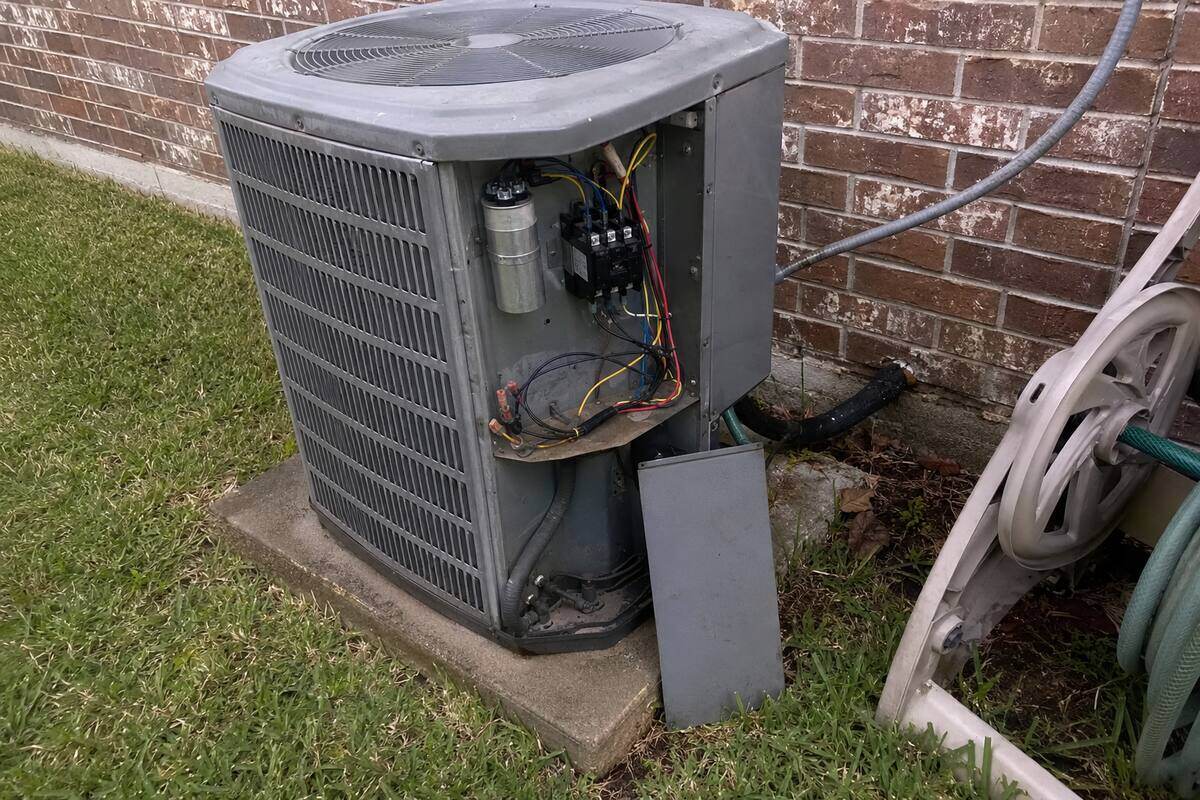
Equipment wears at the rate it is asked to work, and that rate varies more between one end of this county and the other than most homeowners expect. Two examples sitting about twenty miles apart.
A Fulshear or Cinco Ranch house from the 2010s. Owner-occupancy in Fulshear is 90.0% and median household income $187,035 (ACS 2020–2024), and the housing that goes with those numbers is large — frequently two stories, frequently 3,000 square feet or more, and frequently served by one single-stage system and one thermostat mounted on the floor that is already comfortable. That system is asked for full output whenever it runs, and it runs to satisfy a sensor that is not measuring the room with the problem. The complaint is a warm upstairs; the wear is on equipment that never gets a low stage to settle into.
A Stafford rental unit. Owner-occupancy here is 38.7%, the lowest of any Fort Bend city checked. Rental equipment tends to run to failure rather than to plan, so the workload includes years of deferred maintenance that a homeowner’s system would have had corrected. The air handler is usually in an interior closet rather than an attic, the condensers sit in banks, and the condensate line runs above somebody else’s ceiling — which makes a blocked primary drain a neighbor’s water damage rather than yours. What that changes in Stafford.
Same county, same summer, same parts catalog. The reason those two systems fail differently is the building and the tenure, not the weather.
Fort Bend County covers roughly 885 square miles, and contractor density is nothing like uniform across it. Missouri City and Stafford sit inside the Houston metropolitan service area in every practical sense. Needville, thirty-odd miles further south, does not, and the land around Simonton, Orchard, Beasley and Kendleton is further still.
That has three consequences for a repair, and they are worth knowing before the phone call rather than after it.
Silent outdoor unit and humming-but-not-turning are different failures needing different parts on the van. In Missouri City a wrong guess costs forty minutes. South of Richmond it costs an afternoon, and the second attempt may be a different day.
Where a part has to be ordered, the repair becomes a diagnosis visit and a return visit. That is an argument for approving a diagnosis quickly rather than collecting three opinions over three days, because each opinion also costs a trip.
The first contractor who can actually get there is worth more than the cheapest one when a house is gaining a degree an hour. In October the same distance costs almost nothing, which is the practical argument for having anything non-urgent looked at then. Maintenance and tune-ups.
Distance also changes the repair-or-replace arithmetic directly. A part on back order for a week is a different proposition in a house thirty miles from the nearest busy service department than it is in one five minutes from several, and a contractor quoting a Needville or Kendleton address should already know which parts they are unlikely to be carrying.
A like-for-like repair trips no permit trigger anywhere in Fort Bend County, and outside a city neither does a full changeout: the county has not adopted building codes for single-family residential development, and its unincorporated permit list — floodplain work, slabs of 400 square feet or more, platting, driveways, excavation, right-of-way utility work — contains no mechanical item at all. A 2016 H-GAC profile put around 60% of the county’s population in unincorporated areas; annexation since means the current share is likely lower, but the order of magnitude holds.
Inside a city, the picture varies enough that a contractor working across the county is carrying several different answers at once. Missouri City requires mechanical contractors to register with the city at $105 a year, with registrations expiring 30 September. Needville issues its own mechanical permit, inspects Tuesday through Friday only, and takes cash, check or money order — not cards. Meadows Place contracts its plan review and inspections to a third-party building official. Richmond runs the most current code cycle in the county on the 2024 I-codes and the 2023 NEC, while Stafford is still on the 2015 ICC codes and the 2017 NEC under Ordinance 1110.
None of that governs a capacitor replacement. All of it governs what happens if the repair conversation turns into a replacement conversation, which is why it is worth knowing which jurisdiction the address is in before that point rather than after. And a mailing address will not tell you: Texas cities cannot enforce building codes in their extraterritorial jurisdiction at all — Town of Lakewood Village v. Bizios (Tex. 2016), extended to home-rule cities by Collin County v. City of McKinney (Tex. App.—Dallas 2018) — so a Richmond or Fulshear envelope frequently belongs to a house under unincorporated-county rules. The city-by-city position.
A system that cools but leaves the house clammy, or that runs in short bursts and never quite settles, is usually not broken. It is usually oversized — and in this county that is disproportionately a west-side problem, because where hundreds of houses share a floor plan one load calculation tends to get applied to all of them, including the one facing west behind a two-story wall of glass.
The instinct is to buy a bigger machine, which makes it worse. Sizing and load calculations covers what actually decides it, and why almost nothing outside a city line ever checks that the sizing was done at all.
Possibly, and it is one phone call to find out. Manufacturer parts warranties typically run five years by default and ten where the equipment was registered inside a 60- or 90-day window after installation. On a production house that registration was the builder’s job, and on a house that has since changed hands it may also need a transfer request filed within a set period after the sale. Take the model and serial number off the outdoor unit’s data plate and ask the manufacturer directly. A covered compressor and an uncovered one are not the same repair decision, and a great many systems in this county are carrying five years of coverage rather than ten because a form was not filed years ago by somebody who no longer owns the house.
On a house that has never been re-equipped, the condenser, the evaporator coil, the air handler, the drain pan, the secondary line and the ductwork all date from one install week, so they reach the end of their service lives together rather than in a convenient sequence. That does not make an individual repair wrong — a working system is a working system. It means the useful question after the repair is which of the remaining originals is next, and whether that is worth planning for in March rather than discovering in July.
No. The county has not adopted building codes for single-family residential development in its unincorporated areas, and its own permit list has no mechanical trigger — so a repair, and in most cases a full changeout, involves no county mechanical permit and no county inspection. State licensing is unaffected: the contractor still needs a TDLR air conditioning and refrigeration license wherever the property sits, because Occupations Code §1302.251 does not care which side of a city line the house is on. Inside a city the answer changes, sometimes considerably. AC permits in Fort Bend County.
Because contractor density across 885 square miles is nothing like uniform, and because a part that is not on the van has to be ordered. Missouri City and Stafford sit inside the Houston metropolitan area in every practical sense; Needville, thirty-odd miles further south, does not. Two things help. Describe the symptom precisely enough that the right parts travel with the first visit — a silent outdoor unit and a humming one are different failures. And approve a diagnosis quickly rather than shopping it, because out here every extra opinion is also an extra trip.
An R-22 system is by definition pre-2010 equipment, which puts it in the quarter of Fort Bend County housing that predates 1990 or in the early 2000s cohort — either way, well past the age at which the rest of the equipment is also near the end. Production of R-22 ended in 2020 and only reclaimed stock remains, so a refrigerant-circuit failure on one of these is effectively a replacement decision rather than a repair decision. A failure outside the refrigerant circuit — a contactor, a fan motor, a control board — may well be worth fixing. Refrigerant and system age.
Those two facts narrow a Fort Bend repair faster than a description of the noise does. One call gets you connected with an independent TDLR-licensed contractor working in the county.
Call (346) 623-3250 Request a Quote Fort Bend