Home › Services › Builder-Grade Systems and First Replacement
If the house was finished between 2010 and 2019 and nobody has touched the air conditioning since, this page is about your system. It is not broken and it is not a scandal — it is a base-tier unit installed to a price, arriving at the end of its first service life on schedule.
Between 2010 and 2019 Fort Bend County added 92,607 housing units — 30.3% of everything standing in the county today (ACS 2020–2024, table B25034). Most of it went up west and south of the older cities, most of it inside master-planned communities, and most of it was built by production builders working to a specification and a price.
The mechanical system in a production house is a line item in that specification. It is chosen by the builder rather than by the buyer, it is chosen at the base tier unless somebody paid to upgrade it during the option walk, and it is chosen once for hundreds of houses at a time. That is not a scandal — it is how volume homebuilding works, and the equipment is ordinary equipment from ordinary manufacturers. It is simply equipment specified by the person who was not going to live with it.
Fifteen years on, the consequence is arithmetic. Those systems are now seven to sixteen years old. Central air conditioning carries a national life expectancy of 10 to 15 years, from a 2007 NAHB study averaged across all US climates, and Fort Bend runtime pushes real-world outcomes toward the short end. The whole cohort is entering first replacement at once.
Not the brand. The brands are the same ones sold at every tier. What differs is everything around the box.
A base-tier condenser runs at one capacity: full. There is no lower stage to hold on a mild evening, which in a humid climate is exactly when long, low-output run time would do the most good.
The indoor motor is the other half of dehumidification. A fixed-speed blower cannot slow down to increase moisture removal, and it draws noticeably more power over a five-month season.
Where hundreds of houses share a floor plan, one calculation gets applied to all of them — including the one facing west with a two-story wall of glass. See sizing and load calculations.
Flexible duct is fast to install and easy to kink, crush and route the long way around. Return-air paths are the usual casualty: one central return for a house that needed three.
A pan and a secondary line meeting the code minimum, often without a float switch, on equipment that sits over a finished ceiling for the next fifteen years.
One basic control for a two-story house, mounted downstairs, deciding the temperature for a floor it cannot feel. See thermostats and zoning.
Two warranties come with a new system and they behave differently.
The manufacturer’s parts warranty is typically five years by default and ten years if the equipment is registered with the manufacturer inside a window that is usually 60 or 90 days from installation. On a builder-installed system that registration is somebody else’s job, and on a house that changed hands twice it is nobody’s. A great many 2013 systems in this county are carrying five years of coverage rather than ten because a form was not filed in 2013. Whether that can still be fixed depends on the manufacturer and it is worth one phone call with the model and serial number from the data plate.
Transfer on resale is the second trap. Parts warranties are frequently transferable to a subsequent owner, but often only if the transfer is requested within a set period after the sale and sometimes only for a fee. If the house was bought used, the warranty status is a question with an answer, not a mystery — and the answer changes the repair-or-replace arithmetic materially.
The contractor’s labor warranty is a separate document with separate terms and generally does not transfer at all.
Nothing dramatic. A base-tier system in year eleven that cools the house is not an emergency and does not need replacing on principle. Three things are worth doing while there is no crisis:
Find the age. The data plate on the outdoor unit carries a model and serial number, and the serial usually encodes the manufacture date. Fort Bend Central Appraisal District will give you the year the house was built, which on a never-re-equipped house is the same year.
Get the condensate protection looked at. This is the failure that damages the house rather than the failure that stops the cooling, and on a fifteen-year-old installation the pan and the secondary line have never been touched.
Decide before July. A replacement chosen in March is a comparison of three quotes. A replacement chosen on the second day of a heat wave is whoever answers the phone. That is the entire argument for thinking about it now, and it is the only argument this page is making.
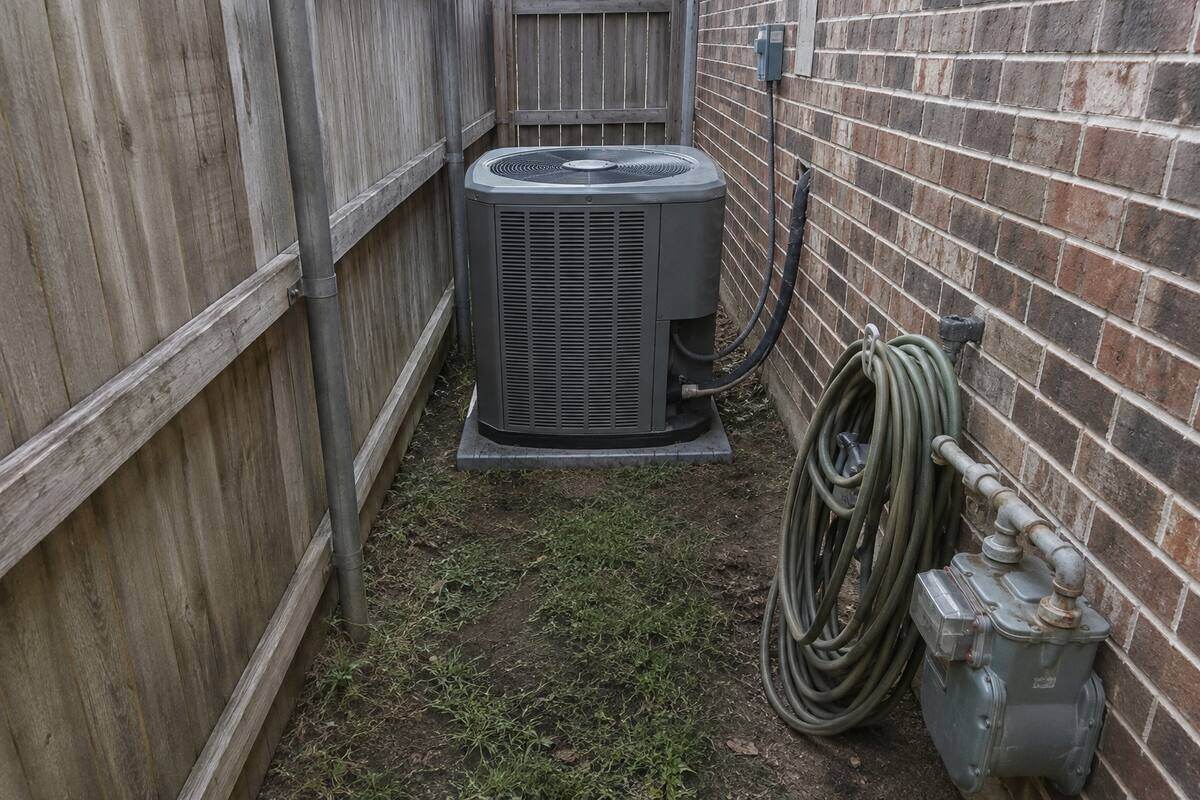
The data plate on the outdoor unit carries the model and serial number, and most manufacturers encode the manufacture date in the serial. If the house has never been re-equipped, the year the house was built is the year the system went in, and Fort Bend Central Appraisal District publishes the year built for any address in the county.
The brands are the same brands sold at every tier. What the base tier gives up is around the box rather than in it: single-stage cooling instead of two-stage, a fixed-speed blower instead of a variable-speed one, minimum-standard duct and return-air design, and a basic thermostat. Those choices matter more in a humid climate than they would in a dry one, because they all reduce the system's ability to run long and slow.
Often, but not reliably, and it is worth checking rather than assuming. Manufacturer parts warranties typically run five years by default and ten if the equipment is registered within 60 or 90 days of installation. A call to the manufacturer with the model and serial number will tell you which applies. If the house was bought second-hand, ask separately about transfer — many parts warranties transfer to a new owner only if requested within a set window after the sale.
Not simultaneously, but on a compressed schedule. On a house that has never been re-equipped, the condenser, the evaporator coil, the air handler, the drain pan, the secondary line and the ductwork all date from the same install week, so they reach the end of their service lives together rather than in a convenient sequence. That is why a capacitor failure on a fourteen-year-old system is a different event from the same failure on a five-year-old one.
It depends on the house rather than on the brochure. Two-stage or variable-capacity equipment and a variable-speed blower are worth most where the humidity complaint is real and the duct system can carry the air. Where the ductwork is the constraint, spending the same money on duct and return-air work usually does more. That is a question a load calculation and a static-pressure reading answer, and both cost very little next to a changeout.
If the house went up between 2010 and 2019 and nobody has touched the equipment since, this is the conversation. Get connected with an independent licensed contractor in Fort Bend County.
Call (346) 623-3250 Request a Quote Fort Bend