Home › Services › Duct Repair and Sealing
Ducts through an unconditioned attic are the regional norm and a measurable efficiency penalty. On the wide single-story floor plans common in the west of the county they are also the reason one end of the house never keeps up.
ENERGY STAR’s figure is that “about 20 to 30 percent of the air that moves through the duct system is lost due to leaks, holes, and poorly connected ducts” — and it flags ducts located in an attic, crawl space or garage as a specific red flag. In Fort Bend County they are in the attic almost without exception, because a slab-on-grade house has nowhere else to put them.
That percentage is doing two different kinds of damage at once, and it is worth separating them.
Supply-side leakage is cooling paid for and never delivered. Air the condenser worked to cool escapes into an attic that is already hotter than outside. It is a straight loss.
Return-side leakage is worse. A leak on the return side pulls hot, humid attic air directly into the system, which then has to cool it and dry it before delivering it. That is why a house can have adequate airflow at the registers and still feel damp: the system is spending a share of its capacity conditioning attic air. Return leaks also pressurize the house slightly, which pushes conditioned air out through every other gap in the envelope.
Separately from leakage, duct conduction gains heat through the insulation on the outside of the run. That is a second penalty, it is not part of the 20-to-30% figure, and it is the reason a long run to a far bedroom delivers air noticeably warmer than a short run to the room next to the air handler.
The single-story and one-and-a-half-story floor plans that dominate the 2010s master-planned sections in the west and south of the county are wide. Two thousand five hundred square feet spread across one floor puts far more linear feet of duct between the air handler and the far bedroom than the same area stacked over two floors would.
Three things follow. Static pressure climbs with length, with every turn, and with every kink in flexible duct — and the blower has a fixed amount of pressure to spend, so the far end of a long run gets the leftovers. Conduction losses scale with length, so the far bedroom loses more of what it was sent. And the return side is usually undersized: a single central return in a hallway is cheap to build and cannot pull air back from rooms whose doors are shut at night.
That combination is why a common complaint in a newer Fulshear, Aliana or Sienna house is not “the AC is broken” but “the back bedrooms are four degrees warmer than the living room and always have been.” That is a duct system report, not an equipment report, and buying a bigger condenser makes it worse rather than better.
Two readings across the air handler with a manometer. It takes minutes, it is the closest thing the trade has to a blood-pressure test, and a high reading tells you the duct system is the constraint before a penny is spent on equipment.
How many returns there are, how big they are, and whether closed bedroom doors strand air on the wrong side of them. Transfer grilles and jumper ducts are the cheap fix and are frequently missing.
Disconnected boots, crushed flex, runs resting on joists with a sag between them, insulation compressed or torn, tape that gave up a decade ago. Most of this is visible from the decking.
Airflow at each register against what the room is supposed to receive. This is where “the back bedroom is always warm” becomes a number rather than an argument.
Sealing means mastic and mesh at joints and boots, or an aerosol sealing process from inside the ducts. Cloth-backed duct tape is not a duct sealant — it fails in attic heat, usually within a few years, and its presence in an attic is a reasonable indication of how the last work was done.
Repair covers the rest: reconnecting boots that have pulled away from ceiling registers, replacing kinked or crushed flex, supporting sagging runs properly, adding returns, and occasionally redesigning a trunk that was undersized from the day it went in.
The sequence that saves money is duct assessment first, equipment decision second. A static-pressure reading and an hour in the attic cost a fraction of a changeout and frequently change what the changeout should be — and new equipment installed against a restricted duct system will never deliver what its rating implies. In unincorporated Fort Bend County, where nothing external inspects a changeout, this measurement is one of the few pieces of independent evidence available about what is actually happening in the house.
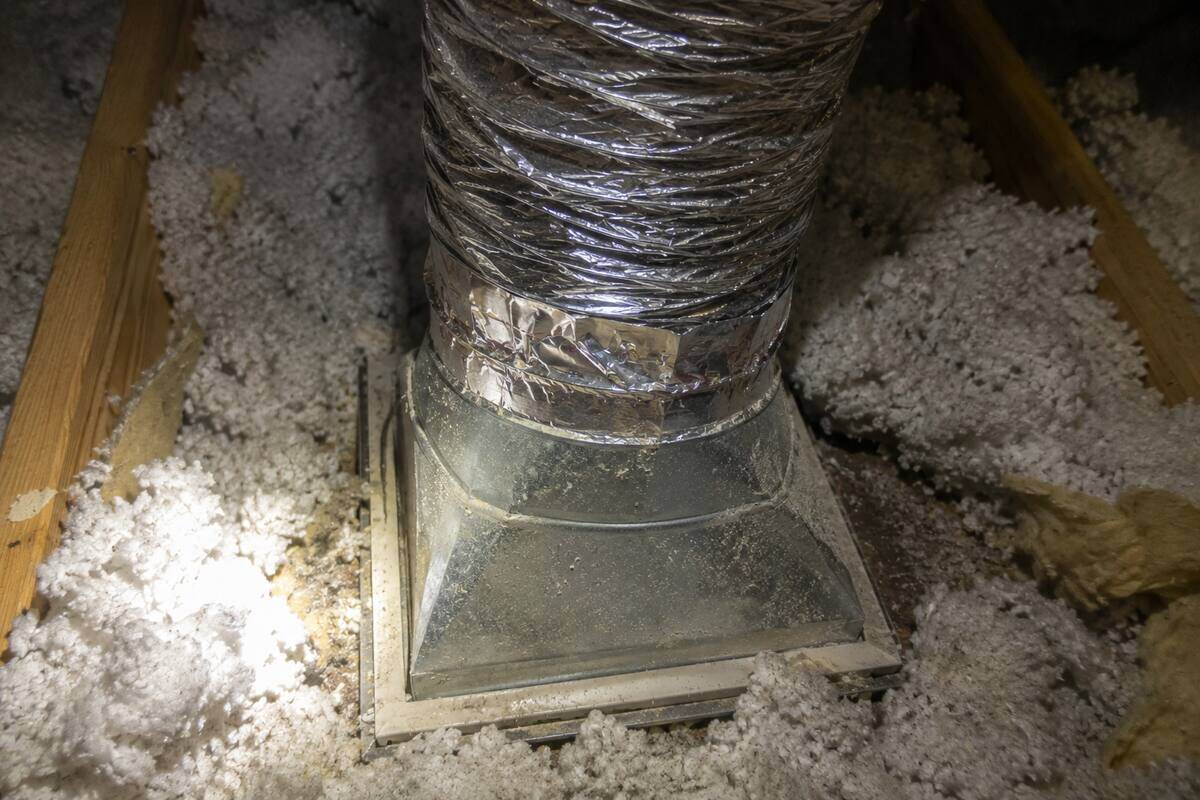
ENERGY STAR puts typical losses at about 20 to 30 percent of the air moving through the duct system, from leaks, holes and poorly connected ducts, and specifically flags ducts running through an attic, crawl space or garage. Conduction through the duct insulation is an additional penalty on top of that figure, and it is why a long run to a far bedroom delivers noticeably warmer air than a short one.
A supply leak loses air you already paid to cool — a straight loss. A return leak pulls hot, humid attic air into the system, so a share of the equipment's capacity is spent cooling and drying attic air before anything reaches the house. That is why a home can have decent airflow at the registers and still feel damp. Return leaks also slightly pressurize the house, pushing conditioned air out through the rest of the envelope.
Usually, and it is a common report in the wide single-story plans built across the west and south of the county in the 2010s. Static pressure climbs with duct length, turns and kinks, so the far end of a long run receives what is left after the near end has taken its share, and conduction losses scale with distance too. If bedroom doors are closed at night and there is one central return, the problem gets worse after bedtime. A bigger condenser does not fix any of it.
No, despite the name. Cloth-backed duct tape fails in attic heat, typically within a few years. The materials that work are mastic with reinforcing mesh applied at joints and boots, or an aerosol sealing process applied from inside the duct system. Finding old duct tape in an attic is a reasonable clue about how the previous work was done.
Assess the ducts first. A total external static pressure reading takes minutes and tells you whether the duct system is the constraint before any equipment is chosen — and if it is, new equipment installed against the same restriction will not deliver what its rating implies. In unincorporated Fort Bend County, where a changeout receives no mechanical permit or inspection, that measurement is one of very few pieces of independent evidence available about the installation.
A static-pressure reading costs a fraction of a changeout and frequently changes what the changeout should be. Get connected with an independent licensed contractor working in Fort Bend County.
Call (346) 623-3250 Request a Quote Fort Bend