Home › Services › Maintenance and Tune-Ups
Most of what goes wrong with a Fort Bend County system is visible months before it fails, and almost none of it is visible from inside the house. This is what the two seasonal checks are actually looking for.
The spring cooling check is a well-established habit here, for the obvious reason: a system that fails in July fails expensively and uncomfortably, and people can feel the season coming.
The autumn heating check is not. In a county recording 961 heating degree days against 4,099 cooling, the heating side reads as an afterthought, and for most of the year it is one. But the failure rate on that side is not driven by how hard it works. It is driven by the seven or eight months it does nothing at all — and every single thing that goes wrong during those months is invisible until somebody runs the system in heat mode and watches what happens.
That is the argument for October in one sentence: it is the only appointment in the heating year that can be made at a normal rate, on a day of your choosing, with time to get a second opinion. Everyone else books theirs in the forty-eight hours after the first cold night.
The one that matters. It separates combustion gases from the air going into the house, and cracks let combustion products — carbon monoxide among them — into the supply air. EPA lists cracked furnace heat exchangers among household sources of combustion products. It has no smell and no warning of its own.
A season of sitting builds an oxide film on the rod that proves the burner lit. The system responds by shutting the gas valve, correctly. Cleaning it takes minutes; discovering it takes running the system.
Hot-surface igniters are brittle and fail cold. A visual and a resistance check in October is the difference between a scheduled part and a Thanksgiving-weekend call.
Nesting material, wasp nests at the flue termination, debris. Attics here are how animals move around a house, and a warm unused compartment is attractive. This is a blocked-flue question, not a housekeeping one.
Whether the inducer proves draft, whether the pressure switch and its hose are intact, and what the flue is actually doing when the burner is lit.
Not equipment, but the thing worth confirming while somebody is in the house: working alarms on every sleeping level. They are cheap and they cover the failure nobody can detect.
The cooling check covers the expected list: coil condition, refrigerant charge and superheat or subcooling, capacitor and contactor condition, amp draws, blower and filter, and temperature split across the coil.
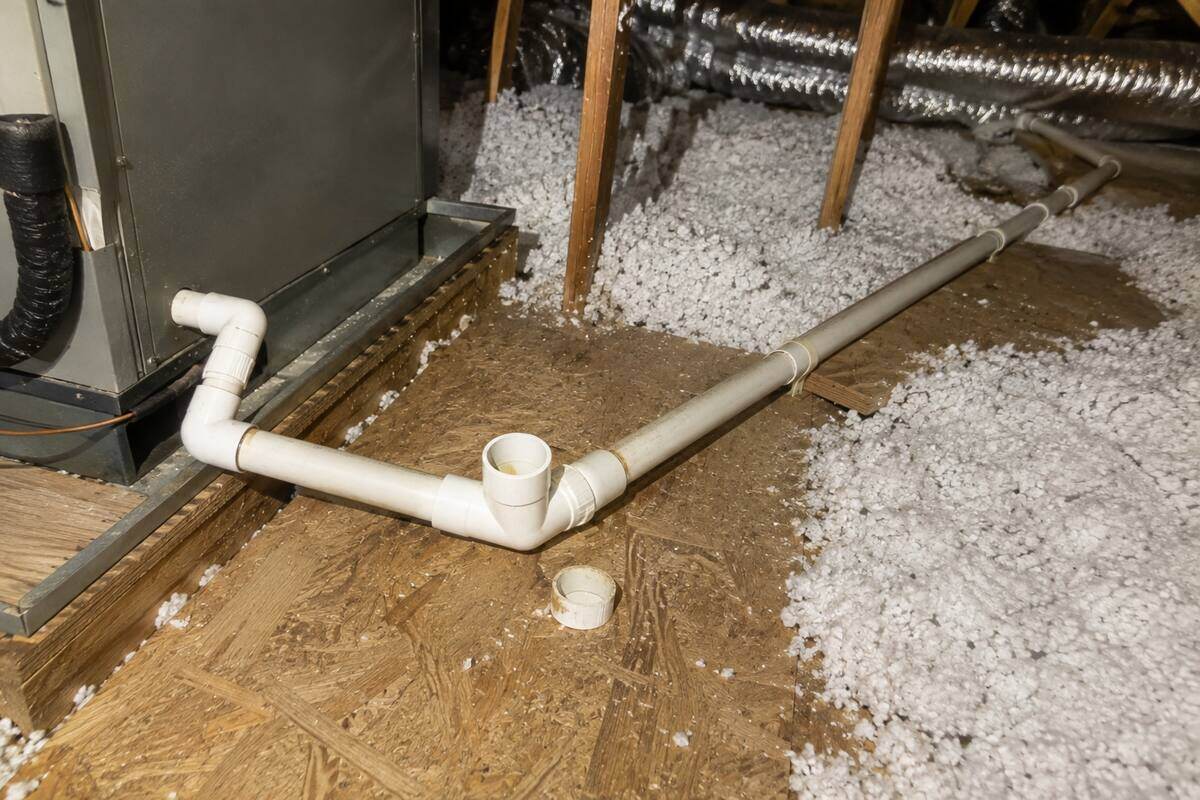
The item that matters most in this county is the one that has nothing to do with cooling. The condensate arrangement. In a slab-on-grade house the air handler is in the attic directly above finished rooms and produces several gallons of water a day through a Gulf Coast summer. Between the water and the ceiling sit a primary drain line, an auxiliary pan, a secondary drain line and, if one was fitted, a float switch. On a system that has never been serviced, none of those has been touched since the house was built.
A blocked primary drain is a cheap thing to clear in April and an expensive thing to discover in August, because what you discover is a stain on a bedroom ceiling. It is the single highest-value item on a Fort Bend County maintenance visit and the one most often left off a low-priced “tune-up” special.
Inside a city, a permit and a mechanical inspection put a second set of eyes on a system at the moment it was installed. In unincorporated Fort Bend County there is no such moment: the county has not adopted building codes for single-family residential development, its permit list has no mechanical trigger, and a city cannot fill the gap in its extraterritorial jurisdiction.
So on a house outside a city, a maintenance visit is often the first time anyone independent has looked at the installation at all. That reframes what the visit is for. It is worth asking, once, for the things an inspection would have covered rather than only the things a tune-up covers: what the total external static pressure reads, whether the return-air capacity matches the equipment, whether the condensate protection is complete and functioning, and whether the equipment size looks right for the house. Those are measurements, not opinions, and they only need taking once.
See AC permits in Fort Bend County for which cities do inspect, and sizing and load calculations for what the size question is really asking.
Change the filter on a schedule rather than on inspection — a pleated one-inch filter through a Fort Bend summer is a one-to-three-month item, and a restricted filter is the most common cause of a frozen coil. Keep two feet clear around the outdoor unit, and keep the fins clear of clippings, which means being careful about which way the mower throws. Watch for a drip from the secondary drain line, usually over an eave or a window — that is the designed warning that the primary drain has blocked, and it means calling now rather than when the ceiling stains. And listen in October: run the heat for fifteen minutes on the first cool evening, deliberately, while it is still optional.
Because the failures are caused by idleness rather than by load. Seven or eight months without running lets oxide build on the flame sensor, degrades ignition assemblies, stiffens seals, drifts thermostat calibration and lets debris and nesting material accumulate in the burner compartment and flue. None of it is detectable while the system sits, which is why it all surfaces on the first cold night — the same night everyone else's does.
The condensate arrangement. The air handler sits in the attic above finished rooms and makes several gallons of water a day through the summer, and between that water and the ceiling there is a primary drain, an auxiliary pan, a secondary line and sometimes a float switch. Clearing a blocked primary drain in April is inexpensive. Discovering it in August means discovering a stain on a bedroom ceiling.
It depends entirely what is on the checklist, and the items most often missing are the ones that matter most locally: a static pressure reading, the condensate protection, and in autumn actually running the system in heat mode long enough to observe the burner. Ask what is included in writing. A visit that measures nothing produces no evidence about anything.
On a schedule rather than on inspection. A pleated one-inch filter through a Fort Bend summer is typically a one-to-three-month item, sooner in a house with pets or during nearby construction. A restricted filter is the most common reason an evaporator coil freezes, and a frozen coil produces warm air at the vents — a symptom that looks exactly like a refrigerant failure.
In one specific sense, yes. Inside a city, a mechanical permit and inspection put an independent set of eyes on the system when it was installed. In unincorporated Fort Bend County there is no such step, so a maintenance visit is frequently the first time anyone independent has assessed the installation. That is worth using: ask once for static pressure, return-air capacity, condensate protection and whether the equipment size suits the house.
It is the one heating appointment in the year that can be made at a normal rate on a chosen day. Get connected with an independent, TDLR-licensed Fort Bend County contractor.
Call (346) 623-3250 Request a Quote Fort Bend