Home › Services › Indoor Air Quality and Humidity
The complaint is rarely that the house will not get cold. It is that the house gets cold and still feels wrong — and the thermostat is the one control that cannot fix it.
Air conditioning does two jobs at once. It removes sensible heat, which is what a thermometer reads, and latent heat, which is the moisture in the air. In a dry climate the second job barely exists. On the Gulf Coast it is roughly half the work.
Houston’s mean dew point in August is 73.5°F — 71.3°F in July, 70.6°F in September. Dew point is the honest measure of how much water is in the air, and a 73°F dew point is a great deal. It arrives in the house through every door opening, every window and envelope leak, and — often the largest single path — every leak on the return side of the duct system, which draws directly from a hot attic. See duct repair and sealing.
The system removes it by condensing water on a cold evaporator coil and draining it away. It only does that while it is running. Which is why the whole subject leads straight back to how long the equipment runs, and therefore to how it was sized.
Indoor relative humidity above roughly 55% through the summer is the measurable version of the complaint. At that level a room at 74°F feels clammy rather than cool, condensation appears on supply registers and cold-water pipes, a musty smell develops, wood floors and doors move, and dust mites and mold have the conditions they want. The instinctive response — set the thermostat lower — makes the house colder and no drier, and costs more.
The most common cause in this county is the one covered in detail on sizing and load calculations: an oversized system that satisfies the setpoint in short bursts and never runs long enough to dehumidify. EPA is direct about it — oversized units short-cycle, “short operation times do not allow the system to effectively remove humidity,” and moisture that has condensed on the coil can even evaporate back into the air between cycles.
The second most common cause is return-side infiltration. The third is a fixed-speed blower that cannot slow down to increase moisture removal, which is standard on base-tier equipment across the county’s 2010s housing. See builder-grade systems and first replacement.
An inexpensive hygrometer in the living space for a week gives you a number instead of an impression. Above 55% through the summer is a real finding; 45–50% is the target range.
Frequently the highest-value work available, because it removes humid attic air from the load rather than making the equipment fight it. Cheap relative to anything involving new equipment.
Running the blower continuously in a humid climate re-evaporates water off a wet coil and pushes humidity back into the house. Auto is usually correct here. Some thermostats offer an overcool-to-dehumidify mode; some do more harm than good.
Two-stage or modulating cooling with a variable-speed blower runs longer and slower, which is exactly what a latent load wants. Worth the tier upgrade specifically for this reason rather than for the efficiency label.
A separate appliance ducted into the system that handles moisture independently of temperature. It is the right answer where the load is genuinely high or the house is unoccupied for stretches, and it is over-specified where the real problem was an oversized system.
Higher-MERV filtration addresses particles, not moisture. It is worth doing and it is a different problem — and a filter with more restriction than the blower was designed for reduces airflow, which makes the humidity worse.
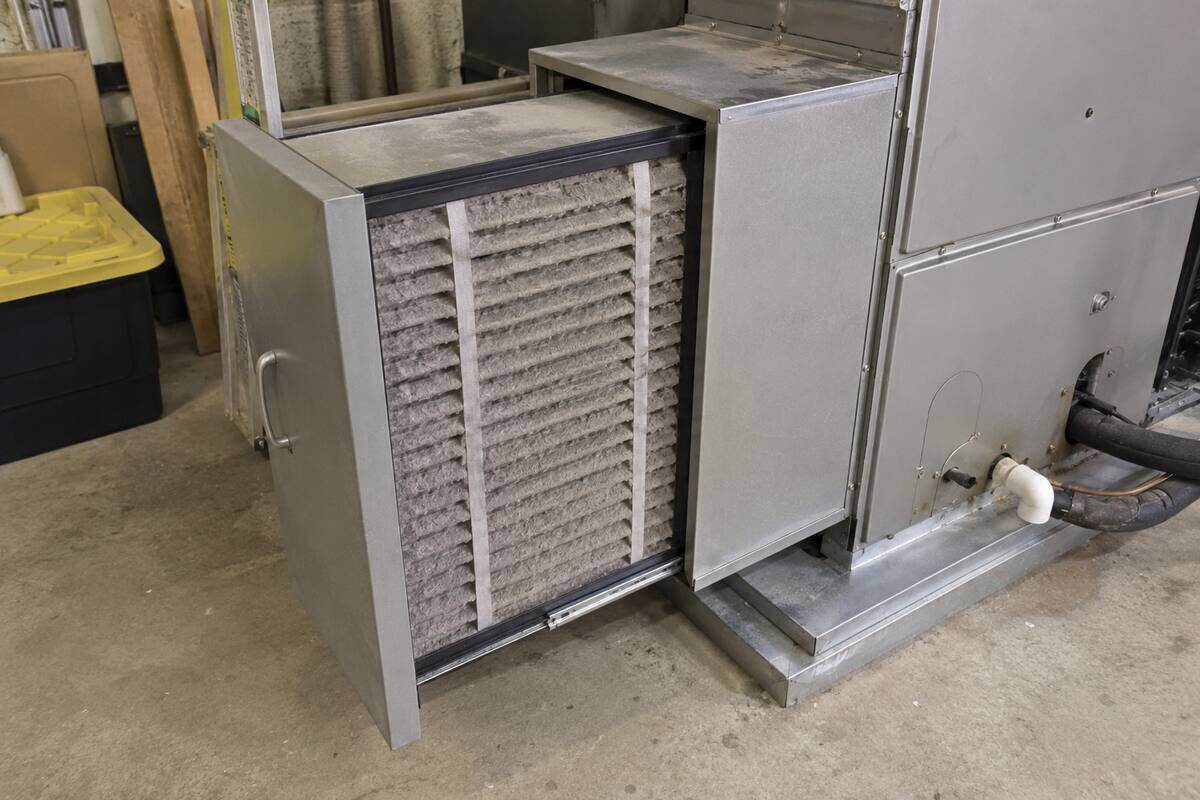
Filtration. MERV 8 catches ordinary dust; MERV 11 to 13 catches a useful share of pollen and finer particles. The constraint is pressure drop — a high-MERV filter in a slot sized for a cheap one restricts airflow, and restricted airflow reduces both capacity and dehumidification. A deeper four- or five-inch media cabinet gives the filter area it needs. That is a real upgrade rather than a consumable.
Ventilation. Newer houses in the county’s 2010s stock are built considerably tighter than 1980s ones, which is good for the energy bill and means less accidental air change. Where mechanical fresh-air ventilation is fitted, it is bringing in outdoor air at a 73°F dew point, so it needs to be controlled rather than left running — a ventilating dehumidifier is one answer.
What to be skeptical about. Duct cleaning marketed as a health intervention has thin evidence behind it and does not address a humidity complaint; there are real reasons to open a duct system, but a photograph of somebody else’s dirty duct is not one. Ozone-generating “air purifiers” are a category to avoid outright — ozone is a lung irritant. And no air-quality product corrects a moisture problem caused by a system that does not run long enough.
Because temperature and humidity are two different jobs and the thermostat only controls one of them. Air conditioning removes moisture only while it runs, so a system that satisfies the setpoint in short bursts leaves the moisture behind. Indoor relative humidity above about 55% through the summer is the measurable version of the complaint, and turning the thermostat down makes the house colder without making it drier.
Roughly 45 to 50% relative humidity through the cooling season, and certainly below 55%. An inexpensive hygrometer left in the living space for a week turns the complaint into a number, which is worth doing before spending anything — it distinguishes a genuine humidity problem from a temperature preference.
AUTO, in this climate, in almost every case. Running the blower continuously moves air across an evaporator coil that is still wet after the compressor stops, which re-evaporates that water and pushes it back into the house. Continuous fan has legitimate uses for filtration and air mixing, but in a humid climate it commonly makes the humidity complaint worse.
Where the latent load is genuinely high — a house left unoccupied for stretches, a pool room, a very tight envelope with mechanical ventilation — it is the right tool, because it handles moisture independently of temperature. Where the underlying problem is an oversized system that never runs long enough, it is an expensive way to work around a sizing error. Measure the humidity and check the sizing before buying one.
The evidence for routine duct cleaning as a health intervention is weak, and it does nothing at all for a humidity complaint. There are real reasons to open a duct system — visible mold, a rodent problem, or debris from construction — but a marketing photograph of somebody else's dirty duct is not one of them. Sealing leaks, particularly on the return side, does far more for both air quality and comfort.
It is usually run time, sizing or the return side rather than the thermostat. Get connected with an independent licensed contractor in Fort Bend County who will measure it.
Call (346) 623-3250 Request a Quote Fort Bend